
Understanding and Defining the Roles
Lived and Living Experience roles exist in diverse organisations and settings, spanning entry level to executive leadership roles. While it’s true that everyone has some experiences of distress and adversity, not everyone has significant challenges that take their lives in an entirely new direction. Lived and Living Experience roles are primarily informed by life-changing challenges and experiences.
What’s in a Name?
Language in this space is evolving and will continue to change over time. There are differences in the preferred language for Lived Experience informed roles in some settings and countries.
Terms to describe personal Lived Experience informed work/perspectives include:
Peer, Survivor, Service User, Consumer, Mad Studies and others.
Terms to describe family/carer Lived Experience informed work/perspectives include:
Carer, Supporter, Family, carers and supporters and others.
At times we use different terms in our research studies depending on the terms common to particular settings or countries. For our broad work we favour Lived Experience, but acknowledge this is not everyone’s preference and respect other terms as part of the multiple perspectives central to this work.
What is a ‘Lived and Living Experience role’?
Personal Lived Experience workers have life-changing or defining, firsthand challenges with distress and adversity, accessed support services or attempted to access services, had periods of healing/recovery, and are employed in diverse roles to use their built or lived expertise to help other people accessing services.
Family/carer/supporters have life-changing experiences witnessing, journeying with and supporting someone with significant challenges, through service use or attempts to access services and periods of healing/personal recovery, and are employed in diverse roles to use their built or lived expertise to help other people who are supporting family or significant others.
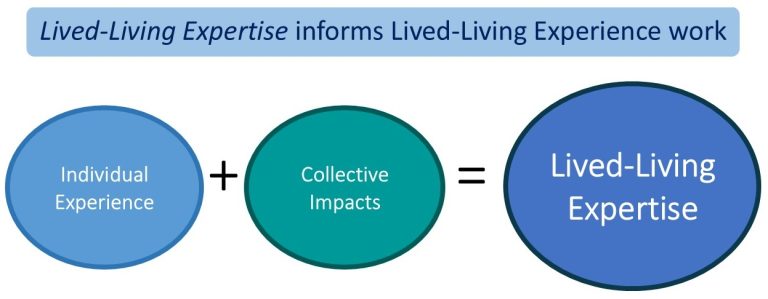
Lived and Living Experience roles are not only informed by an individual’s experience with adversity, service use or even recovery, rather it’s how those experiences are contextualised in relation to Lived Experience concepts and literature, as well as common experiences of marginalisation, loss of identity and impacts on personal agency.
Ultimately, Lived Experience work is about how experiences are understood and applied to benefit others.
Lived Experience workers are commonly employed in settings and services focused on: mental health, disability, suicide prevention, harm reduction/alcohol and other drug use, homelessness, veterans and increasingly in other social services to improve outcomes for people accessing services, their families and significant others. Progressively, Lived Experience roles are also being established within wider industries such as mining, construction and energy to improve the wellbeing of workers.
Lived and Living Experience roles are varied and include positions providing direct support, advocacy, management, research, education, training and/or consultancy.
What is the lived experience needed for Lived and Living Experience roles?
Challenges with distress and adversity (e.g. disability, mental health, alcohol and other drug use) that significantly impact a person’s life so much they significantly incfluence their idea of themselves, their vision for the future and their place in the world.
OR
Experiences supporting someone else with distress and adversity (e.g. disability, mental health, alcohol and other drug use) that significantly impact the supporter’s life so much they significantly influence their idea of themselves, their vision for the future and their place in the world.
+
Personal identification with and experiences of service use or attempts to access services.
Similarities and Differences
There are two key workforces or role types both grouped under the broad umbrella of Lived and Living Experience. These role types are distinct because they have different core informing experiences including roles informed by personal (direct experience) as well as roles informed by experiences supporting others.
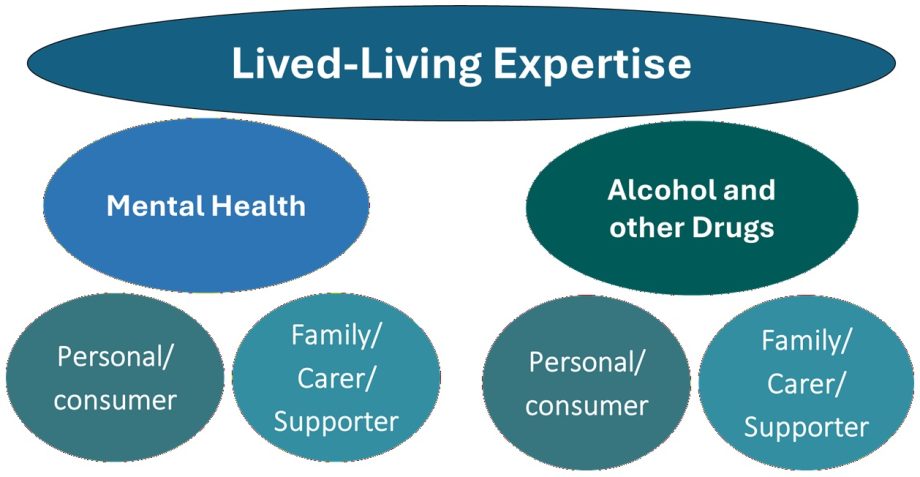
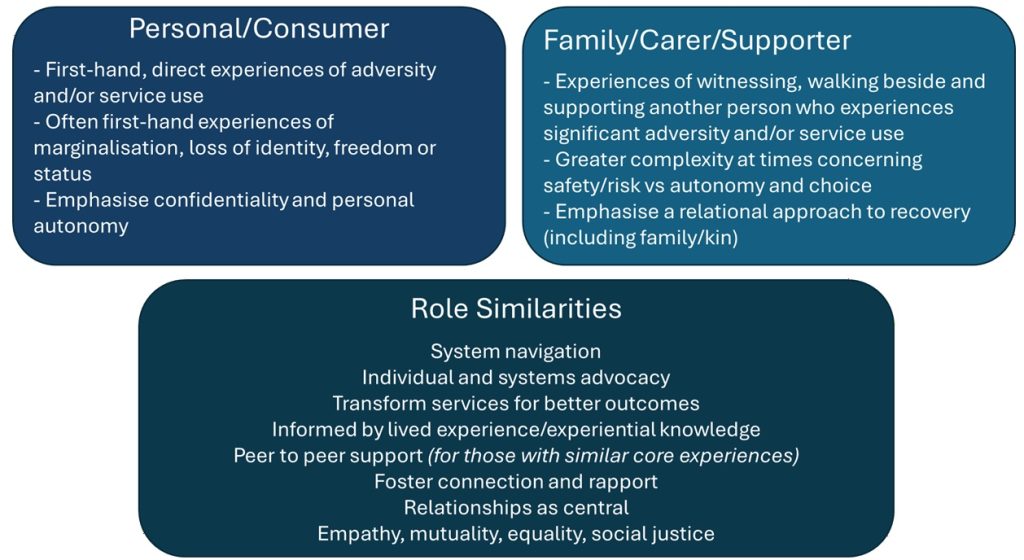
Roles informed by a personal or consumer experience, require first-hand, direct experiences of significant adversity and often service use or, a lack of service access. These roles work primarily with people accessing services on behalf of themselves and often hold a greater emphasis on personal autonomy and confidentiality.
Roles informed by family, carer, or supporter perspectives, draw on experiences and perspectives of witnessing, journeying beside and supporting another person who experiences significant adversity and/or service use. People employed in these roles work primarily with family, carers, supporters or kin of people accessing services, and are more likely to experience complexity at times, in questions of safety and risk versus autonomy and choice and often hold a greater emphasis on what we call relational recovery. Which is a family inclusive approach to recovery.
Personal/Consumer and Family/Carer/Supporter Lived and Living Experience workers share a commitment to transformational change, advocacy, and reform, with both requiring strong leadership, role clarity and professional development to be successful.
The Personal/Consumer and Family/Carer/Supporter workerforces are recognised as distinct workforces with different roles.
Click here to see the Mental Health Family Carer Lived Experience Workforce Discipline Framework (2025), which was written by Stojanovska, D., Alvarez, A., Walters, C., Mercuri, A., Diviney, E., Jonas, R., Peterson, V., Lambert, C. and published by Tandem: Abbottsford, Victoria.
What makes Lived Experience roles effective?
Lived expertise, not just having a lived/living experience but what has been intentionally learned through that experience and how it’s applied to benefit others
Links with and understanding of the wider Lived Experience community and concepts including Lived Experience-led research/training
Work that is values-based and authentically Lived Experience informed, person-directed and aligned with recovery principles
Being an advocate/change agent
A focus on human rights and systems change
Greater flexibility and ability to be responsive to the person accessing services
Significant understanding and ability to use personal story effectively and appropriately for the benefit of the person accessing services
Show that recovery is possible and it’s not a linear journey – it’s natural to have ups and downs and that’s okay
A bridge between organisations and people accessing services/supporting people accessing services
Trauma-informed: awareness of the role and impact of trauma and wish to respond compassionately and sensitively
Ability to challenge power imbalances and provide more equity in support
Strengths-based, focused on the relationship/person
Willingness to potentially face discrimination/negative attitudes as a result of being ‘out’ about their experiences
‘Lived Experience’ and ‘lived experience’
You may notice we alternate between capitalising and not capitalising ‘lived experience’. The capital Lived Experience refers to the professional: designated roles and workforce issues, non capitalised lived experience refers to the personal: having a lived/living experience but not necessarily working from that perspective or building Lived Expertise from those experiences.

Lived Experience Training
Check out our website with courses to embed the research findings and build strong understanding of Lived and Living Experience workforces and practice.